Memorandum
City of Lawrence
City Manager’s Office
|
TO: |
Thomas M. Markus, City Manager |
|
CC: |
Diane Stoddard, Assistant City Manager Casey Toomay, Assistant City Manager |
|
FROM: |
Britt Crum-Cano, Economic Development Coordinator |
|
DATE: |
April 17, 2018 |
|
RE: |
2017 Annual Report: Economic Development Support & Compliance |
The City has released its 2017 Annual Report: Economic Support & Compliance. The report covers public assistance to aid economic and community development efforts, providing details on the project, public assistance provided, and applicable compliance performance measures.
For 2017, the City, along with its economic development partners, supported a variety of assistance programs for both large and small businesses, ranging from pay-as-you-go programs such as property tax abatements, tax increment financing, neighborhood revitalization, and transportation development districts to providing direct support for relocation, infrastructure, historic rehab., business expansion, affordable housing, workforce development, and small business assistance services. In addition to City contributions, a summary of County-only economic development programs is also included.
Property Tax Abatements
2017 saw two projects proceed under the new Catalyst Property Tax Abatement program: VanTrust's Phase I, 150,000 s.f. industrial project is the first to be built in Lawrence VenturePark, a remediated brownfield site. Plastikon's Phase I & II expansion will add another 50,000 s.f. to the existing industrial facility in East Hills Business Park. Both projects broke ground Spring of 2018 and are anticipated to be finished by the end of 2018.
Four traditional property tax abatements were active in 2017, with all companies meeting compliance: Amarr Garage Doors, Grandstand Sportswear and Glassware (Screen-It Graphics), Sunlite Science & Technology, and Rock Chalk Park[1]. Overall, projects receiving tax abatements substantially outperformed projections for the year.
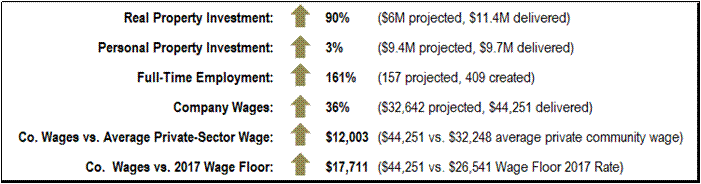
Traditional property tax abatement projects paid approximately $203,000 in property taxes out of a total $357,000 due in 2017, with approximately $153,800 abated.
Industrial Revenue Bonds (IRB)
Five companies had outstanding Industrial Revenue Bonds (IRB) in 2017, the majority of which were not affiliated with a property tax abatement, but rather were utilized to obtain a sales tax exemption on project construction materials. One IRB for the Vermont Place project was authorized in late 2017 but did not have bonds issued before the end of the year.
Estimated sales tax exemption savings on three IRB projects completed in 2017 (800 New Hampshire Street, 1101 Indiana Street, and Pioneer Ridge) was $3.28 million. Of that total, the City contributed an estimated $774,000, the County contributed an estimated $133,400, and the State contributed an estimated $2.37 million in sales tax exemption savings.[2] Note sales tax exemption savings are realized throughout project construction.
Neighborhood Revitalization Areas (NRA)
Of the City’s eight authorized Neighborhood Revitalization Areas (NRA), five projects were eligible for rebates. 2017 Rebates totaled $112,587. After rebates, taxing jurisdictions realized an average of 33% more real property tax revenues in 2017 compared to if these five properties had been left in original condition.
Overall (for all years in which a NRA rebate was given), NRA revitalized properties generated an average of 15.3% more real property tax revenues as compared to property tax revenues that would have been realized if the properties were left in original condition.
Three NRAs have been authorized but were not yet due to receive rebates in 2017: 1101 Indiana Street NRA, 826 Pennsylvania Street NRA, 800-815 Vermont Street NRA.
Tax increment Financing (TIF)
The City continues to support three (3) Tax Increment Financing (TIF) districts.
- The Downtown 2000 Redevelopment TIF District was created to support the development of the City parking garage at 10th and New Hampshire and other cultural, commercial, office, and apartment developments. At the end of 2017, approximately $2.13 million remained outstanding on the $8.6 million bond debt.
· The Oread TIF District was created to help fund public improvements supporting the multi-level lodging, hospitality, and business venues at 12th and Oread. Public improvements to streets and infrastructure, including a parking garage, were financed initially by the developer and are reimbursed annually through both TIF and TDD revenues generated within the district. The district began generating TIF revenues in 2009.
· The 9th & New Hampshire TIF District was created in 2012 and includes two project areas: South (900 New Hampshire Street) and North (888 New Hampshire Street). During 2016, the South Project area generated both TIF sales and property tax revenues, but the North Project was finishing construction and did not have reimbursements.
TIFs distributions totaled approximately $917,300 in 2017.
Transportation Development Districts (TDD)
Currently, the City has three (3) authorized TDD districts. In all TDD districts, public improvements are financed initially by the developer and are reimbursed annually via a one percent (1%) transportation district sales tax on retail or taxable services occurring within the district.
· The Oread TDD District (located at W. 12th Street & Oread Avenue) began generating sales tax revenues in 2009.
· The Free-State (Bauer Farm) TDD District (located at West 6th Street and Wakarusa Drive) began generating sales tax revenues in 2009.
· The 9th & New Hampshire TDD District was created in 2012 and includes two project areas: South and North. During 2016, TDD revenues were generated by the South Project, but the North Project was finishing construction and did not have reimbursements.
TDD distributions totaled approximately $320,500 in 2017.
Direct Support Economic Development Programs
The City also participates in other programs which directly assist economic development services and projects. The programs and projects supported in 2017 are shown below.
|
2017 Other Support Programs |
||
|
Support Program |
Description |
Location |
|
Economic Development Services |
BTBC |
2029 Becker & 4950 Research Pkwy |
|
Economic Development Services |
Chamber and KU-SBDC |
718 New Hampshire |
|
Relocation Assistance |
Integrated Animal Health |
2029 Becker Drive |
|
Workforce Training |
Peaslee Technical Training Center |
2920 Haskell Avenue |
|
Expansion Assistance |
Special Assessment Forgiveness (donated County property) |
3780 Greenway Circle |
Historic Assistance and Investments
As a whole, companies participating in pay-as-you-go (PAYGO)[3] economic development programs received approximately $1.5 million in assistance for 2017 (approximately $153,700 in property tax abatements, $112,500 in Neighborhood Revitalization Area rebates, $917,300 in TIF property and sales tax reimbursements, and $302,500 in TDD sales tax reimbursements).
In 2017, for every $1 in public sector assistance provided for these programs, approximately $4.94 in private sector capital investment was realized.
|
2017 Public Return on Private Capital Investment (by Year) |
|
|
Public Assistance: |
$1,504,216 |
|
Private Investment: |
$7,424,802 |
|
Private Investment for each Dollar of Public Assistance: |
$4.94 |
Recommended Actions
4-17-18: City Commission to receive the 2017 Annual Report: Economic Development Support & Compliance and refer to the Public Incentives Review Committee (PIRC) for review and recommendation.
4-23-18: PIRC to review 2017 Annual Report: Economic Development Support & Compliance and vote on recommendation for City Commission to accept.
5-1-18: City Commission to receive the Public Incentives Review Committee recommendations for the 2017 Annual Report: Economic Development Support & Compliance. Review and accept the report, if appropriate.
5-2-18: County Commission to review the 2017 Annual Report: Economic Development Support & Compliance.